SEO for New Zealand Wineries: How to Grow Your Brand Without Paid Ads
Alcohol advertising is tightly restricted in New Zealand — which makes organic search a winery's single best growth channel. A practical guide to SEO for New Zealand wineries, covering cellar door, ecommerce and export.
SEO for wineries is the practice of making a winery findable in search — by wine buyers, cellar-door visitors and export markets — through organic rankings rather than paid advertising. For New Zealand wineries it matters more than for most businesses, because alcohol advertising is tightly regulated while wine buyers, tourists and international distributors research almost everything online first.
New Zealand makes some of the most sought-after wine on earth. But being brilliant in the glass doesn’t make you easy to find — and unlike most businesses, a winery can’t simply buy its way to attention. This guide covers how New Zealand wineries grow through organic search, whether you sell online, live off cellar-door visits, or export to the world.
Why does organic search matter so much for New Zealand wineries?
Organic search matters because New Zealand wine’s growth is now coming from exactly the places people find through Google: export markets and wine tourism — while the domestic market shrinks.
The numbers make the case. New Zealand wine exports were worth NZ$2.10 billion, with around 90% of all wine produced here shipped to more than 100 countries (NZ Winegrowers Annual Report 2025). At the same time, domestic wine sales have fallen to about 40 million litres a year — the lowest level in three decades.
That’s the strategic picture in two figures: the local market is contracting, and the growth is overseas and among visitors. Both audiences find wineries the same way — they search.
Meanwhile the emerging export markets are moving fast. Shipments to China grew 47% and to South Korea 92%, with second-tier markets collectively up 17% in a year. Buyers in those markets discover New Zealand producers online long before they ever place an order.
New Zealand wineries operate in a market where roughly nine of every ten bottles are sold overseas — which makes online discoverability a distribution issue, not a marketing nicety.
Can wineries advertise online in New Zealand?
Only within tight limits — which is precisely why organic search is so valuable.
Alcohol promotion in New Zealand is governed by advertising codes, and the major platforms (Google, Meta) apply their own alcohol restrictions on top. Paid options exist, but they’re constrained, heavily moderated and easy to get wrong. Always check the current advertising codes and each platform’s alcohol policy before running anything.
Organic search has no such gatekeeper. You earn visibility by being genuinely relevant and useful — an asset that keeps working, rather than a campaign that stops the moment you stop paying.
How do wineries win cellar-door and wine-tourism traffic?
Through local SEO — chiefly a fully optimised Google Business Profile plus content built around region and “things to do” searches.
Wine tourism is one of the healthiest parts of the sector. In 2024, roughly 759,000 international visitors — about 23% of all arrivals — visited a winery or vineyard, and they spent on average 47% more than other travellers. Wine and food tourism together contribute an estimated NZ$1.4 billion a year. These are high-value visitors, and they plan their trips by searching.
What actually moves the needle:
- Google Business Profile. Claim it and complete it fully — hours, cellar-door details, photos, booking links, tasting options, events. This is what appears in Google Maps and the local pack for “wineries near me” or “Marlborough wineries.”
- Region and tourism intent pages. Write for how people really search: “wineries in Marlborough,” “Hawke’s Bay cellar doors,” “Central Otago wine tours,” “Waiheke Island wineries.” Most wineries publish nothing for these queries — which is exactly why they’re winnable.
- Consistent local citations. Your name, address and phone must match everywhere online. Inconsistency quietly suppresses local rankings.
- Booking friction. Visitors increasingly pre-book rather than drop in. If booking is buried, you lose them after doing the hard work of being found.
What content should a winery publish to rank?
Content that answers what buyers and visitors actually ask — region guides, variety explainers, tasting and pairing notes, and cellar-door practicalities.
Winemaking hands you material most competitors ignore:
- Region and variety guides — what makes your sub-region distinctive, how your Pinot differs from the next valley’s. These capture the informational searches that start a buying journey.
- Tasting notes and food pairing — the questions people ask right before they buy.
- The story behind the label — vineyard, vintage, people. Authenticity converts, and first-hand experience is exactly the signal search engines reward.
- Visit content — what to expect, how to book, accessibility, nearby stops.
Each of these can internal-link toward the pages that make you money.
A winery’s website should answer the questions a visitor would ask at the cellar door — because that is precisely what people type into Google before they arrive.
How should wineries that sell online approach SEO?
Treat product and category pages as ranking assets, not just a shop front.
- Optimise product pages with genuine descriptions, variety and vintage detail, and product structured data — not a bare image and a price.
- Build category pages for how people browse: by variety, by region, by occasion, by price.
- Answer buying friction directly — shipping, minimum orders, wine-club benefits, delivery times. These win rankings and conversions.
- Get the technical basics right — fast pages, clean structure, mobile-first. Wine buyers browse on phones.
Does SEO help wineries that export?
Yes — for exporters, organic search is often the primary discovery channel for overseas buyers and distributors.
With roughly 90% of New Zealand wine sold offshore, and second-tier export markets growing 17% year-on-year, being visible in those markets matters commercially. This is where a properly localised, multi-country website earns its keep. Correct hreflang and country targeting mean a UK buyer and a US buyer each land on the version built for them, instead of a mismatched page. It’s fiddly to set up and easy to break — but for an exporting winery it’s the difference between being found in your markets and being invisible in them.
What does organic growth actually look like for a drinks brand?
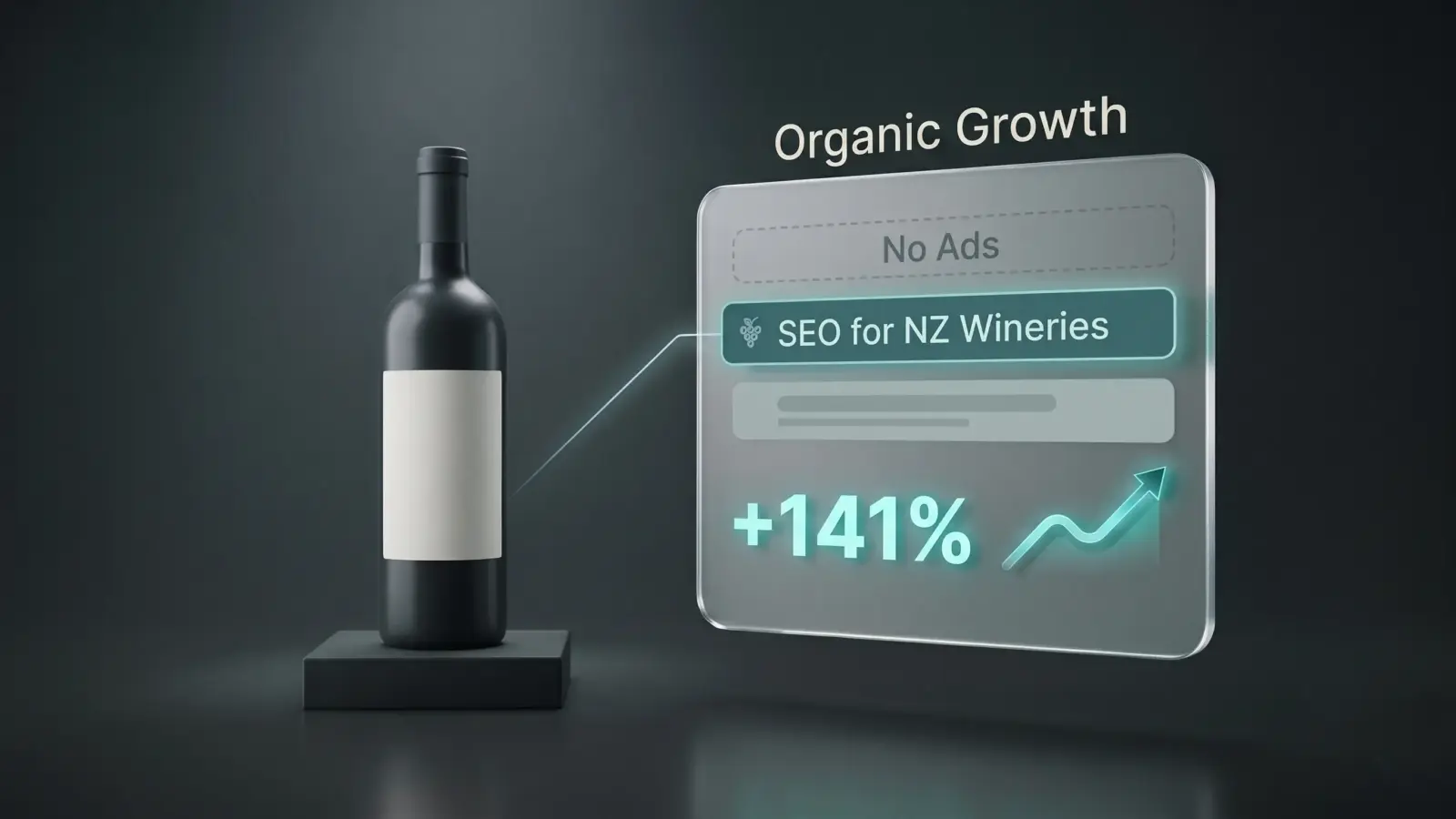
Here’s a real result: we grew a wine brand’s organic revenue by 141% in twelve months — full-funnel organic work, with no reliance on paid advertising.
We’ve also taken a New Zealand business from the bottom of page five to the top of page two, lifting Top-3 keyword rankings from 16 to 54 and organic users by 110%, entirely through organic and local SEO. The approach in both cases is the one described in this guide: earn the right rankings, convert the visitors who arrive, and let the results compound.
See the proof
- Read the New Zealand local SEO case study — organic users +110%, page five to page two.
Common winery SEO mistakes
- A beautiful site with almost no text — gorgeous to look at, invisible to search engines.
- No Google Business Profile, or an abandoned one.
- Product pages with no words on them.
- Ignoring region and wine-tourism searches entirely.
- Chasing the occasional paid campaign instead of building an organic asset that keeps paying.
Frequently Asked Questions
Can wineries advertise online in New Zealand?
Within limits. Alcohol advertising is regulated by advertising codes and by the platforms themselves, so paid options are constrained and closely moderated. That's why organic search — which you earn rather than buy — is so valuable for wineries. Check current codes and platform policies before running any paid promotion.
Do I need an online shop to benefit from SEO?
No. Many wineries grow through cellar-door visits, tourism and export enquiries. In 2024 around 759,000 international visitors went to a winery or vineyard in New Zealand, spending about 47% more than other travellers — local SEO and region content capture that demand without selling a bottle online.
How long does SEO take to work for a winery?
Local and technical wins can show within a few months; competitive terms and export visibility build over six to twelve. It compounds — our New Zealand local SEO engagement reached +110% organic users over roughly fifteen months.
Is SEO worth it if most of my wine is exported?
Yes — arguably more so. Around 90% of New Zealand wine is exported to over 100 countries, and overseas buyers, distributors and consumers research online first. Correct multi-country SEO puts you in front of them in their market.
How much does winery SEO cost in New Zealand?
It depends on your goals — cellar-door visibility, online sales and export each require different work. We scope it to your winery and quote after a free audit, so you only pay for what will move your numbers.
Ready to Be Found?
Book a free winery SEO audit — we'll show you exactly where the search opportunity is in your region, your online shop and your export markets.